Trading signals can initially seem like a win-win form of collaboration. A signal provider — whether a trader, analyst, or algorithmic system — offers advice on how to make profits. The subscriber follows the signal and typically shares a portion of their earnings with the provider.
In reality, signal trading comes with various nuances and risks. Trading signals are an extremely popular niche, especially among cryptocurrency traders. To help beginners navigate signal trading, we have compiled brief overviews of different providers in this article.
The text mentions third-party services that are not affiliated with the ATAS platform. The ATAS team does not endorse using these services but aims to inform you about the various options available. You are responsible for your own trading decisions.
Read more:
What Are Trading Signals?
Trading signals are specific instructions to execute a trade on the exchange. Typically, a trading signal includes:
the name of the market;
the direction of the trade – buy or sell;
the entry and/or exit price;
additional information (optional).
How Do Trading Signals Work?
The basic process is simple:
The signal provider, whether a robot or a human, monitors the markets;
When a setup is detected, the provider sends out a signal;
The subscriber receives the signal and acts on it, either manually or automatically.
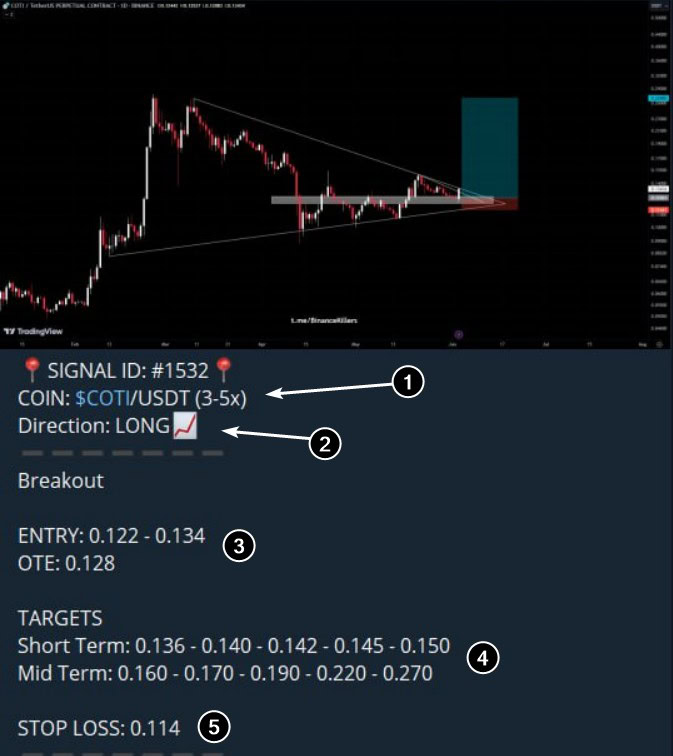
Example. A trading signal in Binance Killers, one of the popular Telegram groups for crypto trading, which we will discuss in more detail later in this article:
The signal shown is based on a triangle breakout, and the author anticipates an upward movement that surpasses the previous high.
The signal includes all the essential information:
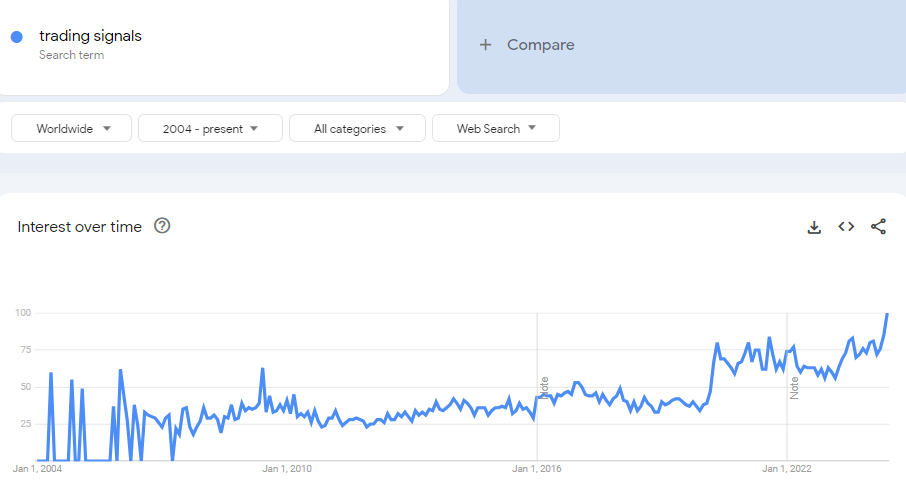
Google Trends shows that trading signals are gaining popularity and becoming more diverse. Let’s explore the different types of trading signals.
Types of trading signals
By market type
By holding period
By provider type
By distribution method
forex;
crypto;
stocks;
futures;
combined.
short-term;
medium-term.
manual
(signals generated by professional traders or analysts);
automated
(signals generated by algorithms and trading bots based on data analysis and preset strategies, without human intervention).
social networks and messengers (Telegram, WhatsApp);
signal platforms and trading terminals;
brokers.
By analysis method
By cost
Based on additional information
Based on reputation
fundamental: based on economic indicators, news, and other external factors.
technical: based on price charts, patterns, indicators, and other technical tools.
social: take into account the actions of other traders, such as large market liquidations that can impact market movements.
paid: subscriptions can range from $30 to $100 per month, which is justified if the signals are profitable;
free: often used to attract an audience or demonstrate capabilities.
educational: signals accompanied by educational materials explaining trading strategies and methods;
news: include important market events that could impact asset prices;
memes: information in channels with trading signals is presented in an entertaining manner, sometimes using humor to grab traders’ attention.
high reputation: these signals are provided by real public figures whose competence is verified. Additionally, the provider may have a legal entity, licenses, broker statements, and other supporting documents.
low reputation: unfortunately, the majority of providers fall into this category. Subscribers do not have access to information about the trader’s identity, the effectiveness of their strategy during testing, or evidence of the provider’s integrity.
Signal Trading – Who Is It Suitable For?
Beginner traders: Trading signals help newcomers understand how the market works. They can learn from experienced traders’ examples and develop discipline. Signal trading can reduce risk by providing clear entry and exit recommendations.
Passive income seekers: For those who prefer not to delve deeply into market analysis, trading signals offer a way to earn passive income. They simplify the trading process, requiring less technical and fundamental analysis knowledge and allowing for profit without constant market monitoring.
Traders looking to diversify their strategies: Signals can complement existing approaches by offering opportunities to balance a portfolio of strategies.
Traders in search of new ideas: Signals present trade opportunities that traders might otherwise overlook. It enables them to engage with a broader range of markets.
Experienced traders: They can leverage their expertise by generating their own signals and becoming signal providers, thereby increasing their income.
Regardless of your trading level and goals, it is crucial to use trading signals with caution, combining them with your own analysis and risk management strategies.
Overview of Trading Signals
Crypto Trading Signals on Telegram
A Google search for “best crypto trading signal Telegram” returns numerous results. For our analysis, we randomly selected a group from the top results called Binance Killers.
This provider of cryptocurrency trading signals claims a 92% success rate for its signals. An example of a signal was presented earlier.
Such a high percentage might raise suspicions about the calculation methodology, but the explanation could be simpler. If you trade based on moving average crossovers with a 50% chance of profit and your stop-loss is ten times the size of your take-profit, hypothetically, your take-profit would trigger ten times more often. This would justify claiming that only 1 out of 10 trades results in a loss. Voilà, a 90% success rate!
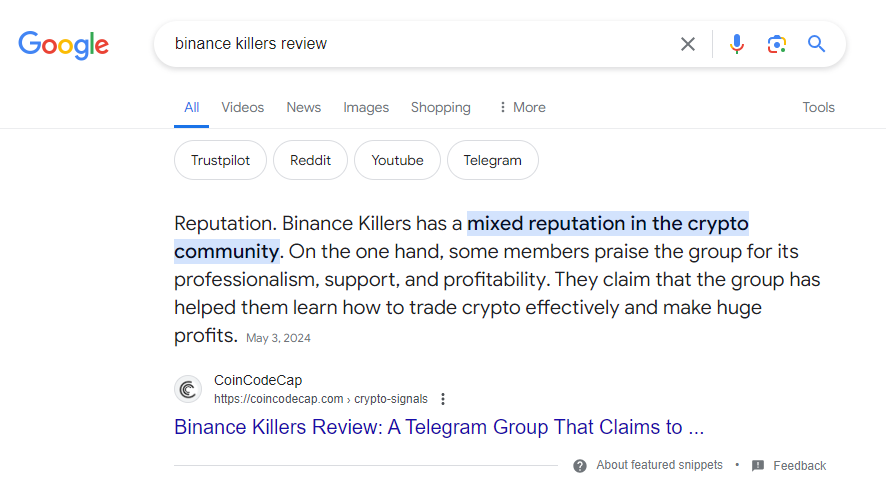
Dubious reviews on forums warrant caution:
Binance Killers follows a common strategy for their trading signals:
They create two channels: one paid and private, the other free and public.
The free channel shares profitable signals from the paid group, encouraging the audience to subscribe to the paid channel for $100 a month.
Unsuccessful signals are conspicuously absent from the free group.
Whether paying one hundred dollars for signals on simple chart pattern breakouts is worth it is a question of personal choice.
Copy Trading on Binance
Copy trading is a specific form of signal trading where users can automatically replicate the trades of successful traders.
This allows beginners or less experienced investors to follow the strategies of professionals, minimizing risks and saving time on market analysis. Typically, providers charge around 10% of the earned profits for their services.
To start trading crypto with Binance Copy Trading signals, you need to:
fund your Spot account and go to the Binance Copy Trading page;
select signal providers based on performance metrics like profit curve, maximum drawdown, and return rate;
subscribe to a trader’s signals and specify: a) the amount to trade with; b) acceptable drawdown levels (stop-losses); and c) other parameters;
confirm your decision.
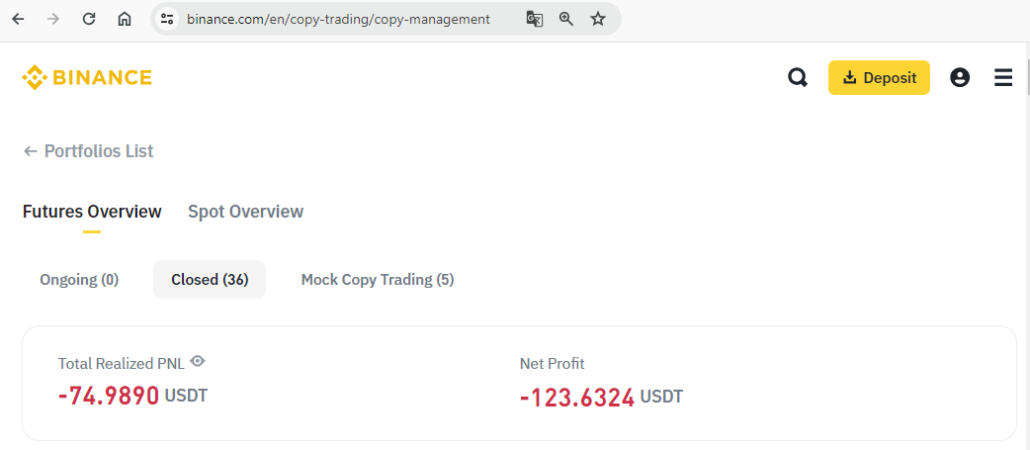
How profitable is trading with Binance Copy Trading signals? Below is the cumulative negative result from following signals of 36 different providers:
Signal trading was profitable when the market was steadily rising — likely because the signals were based on trend-following strategies. However, as soon as the market made a move against the trend, some trades were closed due to stop-losses, which were set at 15-20% of the invested amount. Over the long term, none of the signal providers “survived” — perhaps because the stop-loss levels were too tight. Among professional money managers, a 20% drawdown is considered unacceptable.
The results could have been better if the quality of the signal providers was higher. However, on Binance Copy Trading, providers with a high reputation typically set minimum requirements for those who want to copy their trades. For example, $3000-5000.
Similar signals on other cryptocurrency exchanges include:
…and others. Almost every top cryptocurrency exchange offers a copy trading service as a form of signal trading. This feature attracts clients.
Forex Trading Signals
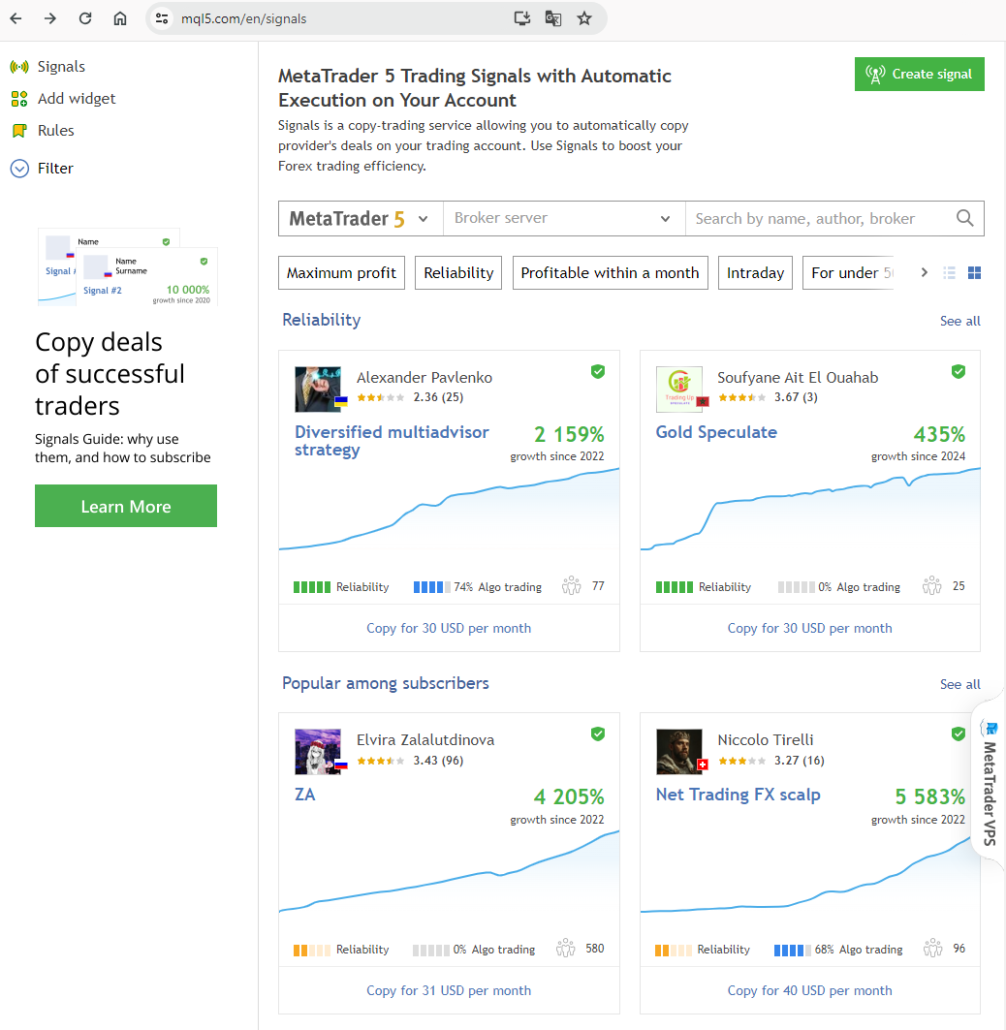
On the MQL5 portal, you can automatically copy trades from successful traders to your account.
Unlike Binance Copy Trading:
you need to pay a fixed fee for copying signals, which can be a downside (typically $30-$50);
more detailed statistical data is provided when selecting a provider, which is a good thing.
To start trading with these signals, you need to:
open and fund an account with a broker that supports Metatrader terminals;
choose a signal provider;
make the payment;
monitor the results.
Is it worth it? Let’s discuss this further below.
Automated Trading Signals Based on Chart Patterns
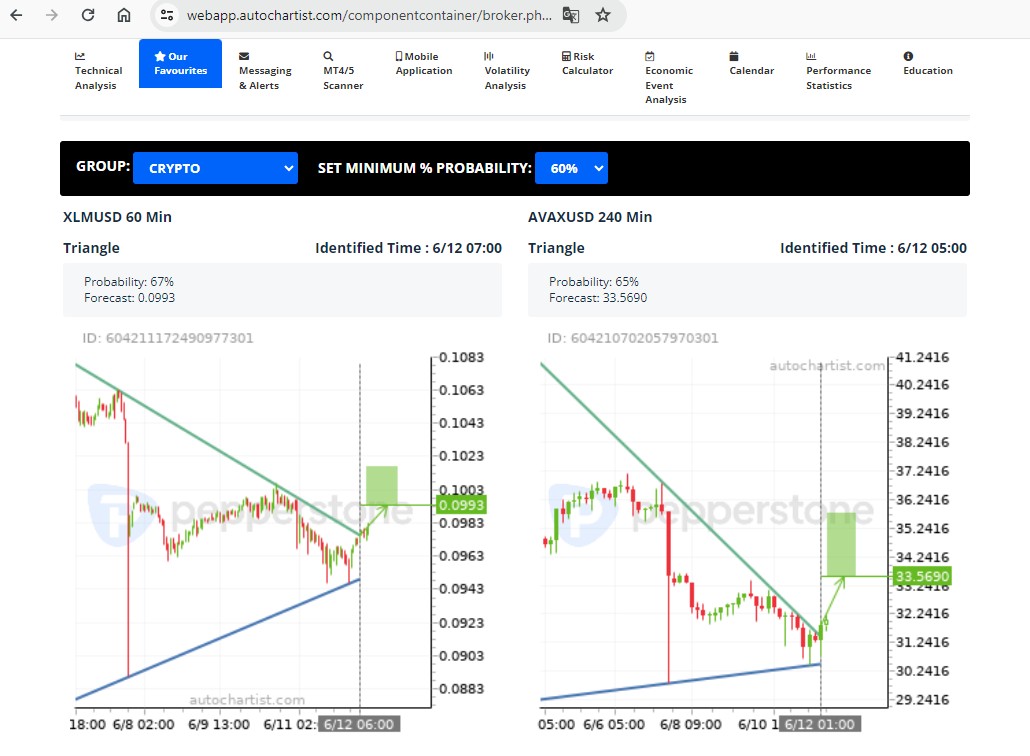
Another option for signal trading is Autochartist, a service offered as an extra tool for clients of various brokers.
This service automatically scans markets, identifies patterns, and sorts them by probability and market type (crypto, forex, other assets).
The advantage is that traders receive specific target levels, enabling them to choose whether to follow the signal. The downside is that signals are not as frequent as one might like.
Alerts
Alerts are customizable notifications that trigger when specified conditions are met.
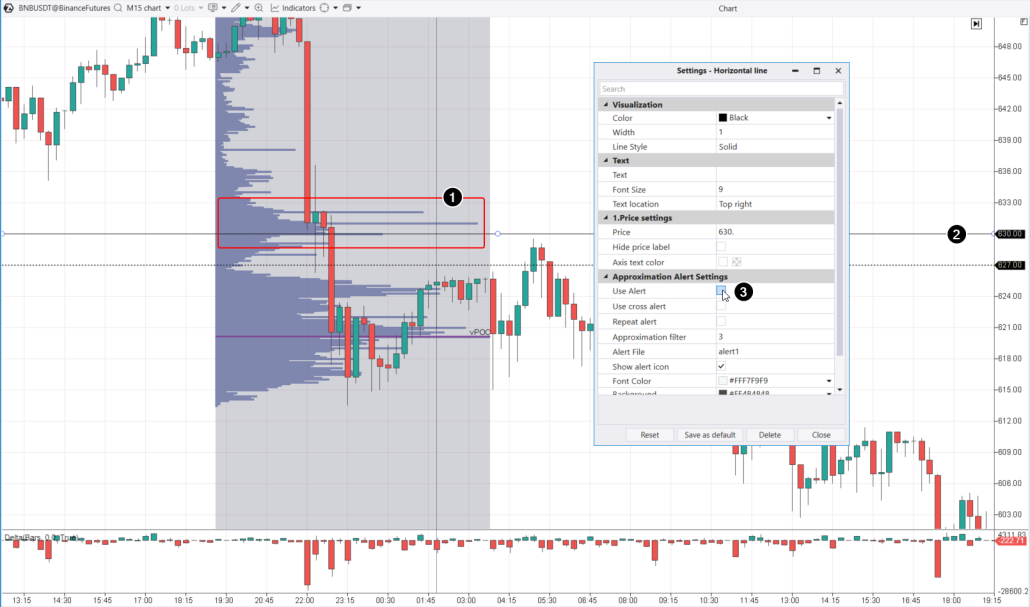
For example, in the ATAS platform, you can:
identify a large volume on the market profile indicator (marked as 1);
create a level (2);
set up an alert to trigger when the price approaches this level and receive a notification on Telegram (3);
make a trading decision based on the alert, considering additional volume and price analysis on lower timeframes.
This enables you to:
manage multiple markets with less time investment;
share trading signals on Telegram, i.e. becoming a signal provider for other traders.
We recommended reading a blog article: Copying Trades Using the ATAS Following Manager
Signal trading is also called social trading because it involves elements of interaction and collaboration among traders. Here is a compilation of resources directly related to copying signals from traders:
Zulutrade.com – a platform that enables the automatic replication of trades from professional traders and delivers real-time signals.
eToro.com – a brokerage providing a social trading platform where users can copy trades from experienced investors and communicate with them.
3Commas.io – a platform designed for automating cryptocurrency trading, featuring signals and trading bots.
Darwinex.com – a functional platform where investors can build portfolios from the strategies of professional traders.
Signalstart.com – a service offering trading signals for automatic copying on your accounts.
Myfxbook.com/reviews/signal-providers – reviews of trading signal providers.
Covesting.io – a platform dedicated to social trading, enabling the replication of trades from successful crypto traders.
Collective2.com – a social trading platform where you can track strategies from experienced traders and replicate their trades.
Wunderbit.io – a platform for cryptocurrency trading that provides trading bots and signals for automatic replication.
NAGA.com – a social trading platform offering the option to copy trades from successful traders and receive trading signals.
Zignaly.com – a platform for cryptocurrency trading offering signals and trading bots for automatic replication of trades.
Trading signals are recommendations to buy or sell financial instruments based on market data analysis.
Are trading signals legal?
Yes, trading signals are legal; however, their use must comply with the laws and regulations of the specific country.
Do trading signals work?
They do not work as well as they are advertised.
Are trading signals the same as copy trading?
Trading signals and copy trading are not synonymous. Copy trading is a specific aspect of the broader concept of signal trading. In copy trading, users of copy trading platforms automatically replicate the trades of professional traders in their own accounts.
Where can you get trading signals?
Trading signals can be obtained from specialized platforms such as MQL5, eToro, ZuluTrade, Telegram, and others, as well as from independent analysts and traders.
Which trading signals are the best?
There are no signals that are best for all traders. No reputable signal provider can guarantee a 100% probability of profit.
Is Signal Trading Worth It?
Deciding whether to trade based on signals requires carefully weighing the pros and cons.
Advantages of Using Trading Signals
Wide selection. Various resources offer thousands of signals that you can copy to your account either manually or automatically.
Statistics. Signal providers usually offer trading history, though this is not always the case with Telegram signals.
Accessibility. Setting up signal trading is usually quite simple. If you are trading through a broker, customer support can assist you.
Potential high profit. By sorting the available trading signals by profitability, you will find that the top providers often show the highest returns.
Control. You can configure your trading to maintain constant access to your funds and manually decide whether to execute a trade based on the signal.
Legality. Signal trading is generally legal, although some copy trading platforms may restrict services to residents of countries like the US and UK due to legal risks.
Disadvantages of Using Trading Signals
Lack of trust. The identity and qualifications of signal providers are often unverified. Subscribers may find themselves with limited information about the profitability of the strategies used. To attract subscribers in a competitive market, providers might use high-risk strategies like Martingale, which can show high returns but only over a short period.
Costs. These can include the subscription fee for the signal provider (typically $30-100/month), the cost of VPS services, and commissions. A significant starting capital might be required to ensure the potential income from the signals exceeds the expenses, which increases the risk for beginners.
Need for diversification. This fundamental rule in financial markets raises the initial deposit requirements to subscribe to more than one trading signal.
Time lag. Manually confirmed signals can lose their relevance if not acted upon promptly.
Technical issues. Actual results can vary due to possible slippage or differences in spreads, which can vary among brokers or exchanges.
Inconvenience — trading signals might be sent when you are asleep or busy with other important activities.
Qualification requirement. When manually confirming signals, it is helpful to have experience and knowledge of technical analysis to understand how suitable the signal is for you.
The main drawback — past results are not a reliable indicator of future performance. Market volatility, analyst errors — whatever the reasons may be, there are no guarantees that trading signals will not lead to losses.
Therefore, you should have a clear plan that includes risk management when you start signal trading.
Tips for Beginners on Copying Trading Signals:
Explore a wide range of signal providers. Analyze providers’ statistics: historical profitability, maximum drawdowns, trade frequency, and feedback from other users.
To choose reliable trading signals:
Study the trader’s statistics: profitability, maximum drawdown, percentage of successful trades, and trading style (aggressive or conservative).
Check the trading history: how long they have been in the market and the consistency of their results.
Gather opinions from other users and check the provider’s rating on the platform.
Start with a demo account. Before investing real money, test the signals (if available) to understand how they work and determine if their strategies suit you.
Define your risk level:
Set an acceptable risk level for your account.
Only invest what you can afford to lose without regret.
Adjust risk parameters, such as stop-loss (if available), to automatically stop signal trading during unacceptable drawdowns.
Diversify. Do not put all your funds into one signal provider. Spread your investments among multiple traders to reduce risks.
Monitor results regularly. Adjust settings as needed.
Do not expect big and easy profits. Even the most successful traders can make mistakes, and some average traders may be good marketers. Prepare yourself mentally for potential losses and avoid making impulsive decisions.
Keep learning and developing. Read trading materials to gain a deeper understanding of the process. This way, you will be able to better distinguish between good and not-so-good signals. Moreover, as you advance to a professional level, you can even become a signal provider on various platforms and expand your profit potential.
Read materials on the Learn tab in the main menu of the ATAS platform.
Explore ATAS tools like professional-grade cluster charts, the Smart DOM order book, Smart Tape, useful indicators, and more.
Read helpful articles about trading strategies in our blog. Your trading advantage may be based on technical analysis, volume analysis.
How Much Do You Need to Start Signal Trading?
Do you want to take a risk and try signal trading? How much do you need?
Based on your preferences, you decide that:
to diversify, you need to copy signals from at least 5 providers;
the potential profit from the signals should exceed their fixed cost by 5 times.
Then, without considering additional expenses that may arise:
Economical Option 1. Copying trades on Binance
There is no fixed cost, and beginner signal providers offer a minimum threshold starting from $10. You would need around $100 to allocate $20 to each of the strategies.
Expensive Option 2. Trading MQL5 Signals
Let’s say you have chosen 5 signal providers with an expected monthly return of 10% and a subscription cost of $30 per signal per month.
If your signal expenses are $30, then the profit threshold should be $150. With an expected 10% return on one signal, you would need to invest $1500.
And with 5 signals, you would need $7500 initially to spend a fixed amount of $150 per month and expect the signals to yield $750 in profit.
Conclusions
Signal trading can be profitable, but it is not a fast or easy way to get rich.
It is likely that before you become skilled at investing in a portfolio of trading signals, you will face some losses. Before diving into signal trading, take all necessary precautions — thoroughly research this area and avoid taking on excessive risk.
For those with trading experience, signals can diversify your income. However, if you are new to the market, it might be worth investing time and effort to learn how to profit from your own trading decisions.
Download ATAS.It is free. During the trial period, you will have full access to the platform’s tools to experiment with various stock and futures trading strategies and determine which one suits you best. Moreover, you can continue using the program for free even after the 14-day trial period is over, whether it is for cryptocurrency trading or volume analysis in futures markets.
Do not miss the next article on our blog. Subscribe to our YouTube channel, follow us on Facebook, Instagram, Telegram or X, where we publish the latest ATAS news. Share life hacks and seek advice from other traders in the Telegram group @ATAS_Discussions.
Information in this article cannot be perceived as a call for investing or buying/selling of any asset on the exchange. All situations, discussed in the article, are provided with the purpose of getting acquainted with the functionality and advantages of the ATAS platform.